Tuesday, May 18, 2010
bok choy for a change
Here's the bad news: our camera lens broke. This means that my photos are going to be even more mediocre than usual for the next little while.
But here's the good news: I found something different to do with baby bok choy.
I'd seen the stuff at the farmers market for several weeks running, and it seemed like it might make a good change from the endless bunches of chard and kale we've been eating (that's how you can tell you live in Seattle: your idea of a welcome change from greens is...a different kind of greens). But all I could think of to do with it was to make stir-fry with garlic sauce. Which, don't get me wrong, is delicious, but I wanted something...different.
This recipe fits the bill--roast the cabbage briefly in a very hot oven, then douse it in lemon juice and lemon zest. It's a kind of Marco Polo of a recipe, transporting bok choy from Asia to the Mediterranean.
The original recipe, from Eating Well, is a side dish, but I wanted to make it into a main (translation: I am lazy, and prefer one-dish meals). I glanced at the package of soba noodles sitting in a canister on the counter but initially dismissed them as a possibility--I wanted to keep the dish in the Western Hemisphere. Because I wanted something different. Then I remembered that Italy also has a buckwheat pasta tradition--pizzoccheri, or buckwheat noodles that are typically combined with greens and cheese. Bingo. We have a winner: a quick spring supper that nods to the flavors of a famous peasant dish.
Making this dinner also made me think about the sometimes contradictory and inconsistent rules I have about cooking and eating local food. For example, if a food grows here but isn't in season (tomatoes), I won't buy it. But if a food doesn't grow here at all (lemons), I'll freely use it any time of year. Except that doesn't even quite cover it. I buy bananas nearly every week (though mostly for the sake of my Monkey)--but I'd never buy a pineapple. That totally doesn't make sense, does it? This kind of thing is exactly why I say this blog is about cooking local "in theory and practice"--sometimes there's quite a gap between the two.
How about you--do you have rules, informal or strict, logical or wildly inconsistent, about buying local produce?
Buckwheat Noodles with Lemony Roasted Bok Choy
Adapted from EatingWell
The original recipe calls for tarragon, which I left out because I didn't have it on hand. I think I might add about a teaspoon of fresh thyme next time.
A large bunch of baby bok choy
1 Tbsp olive oil
1 clove garlic
Salt
Freshly grated zest of about 1 lemon
Juice of 1/2 lemon
1 teaspoon mirin, or sherry with a pinch of sugar
Ground black pepper
About 6 oz. dried soba noodles
1 Tbsp olive oil
1 clove garlic
Salt
Red pepper flakes
Parmesan cheese
Put a large saucepan of water on to boil for the pasta. Adjust an oven rack to the lowest position and preheat the oven to 450 F.
While you wait for things to heat up, wash the bok choy, trim the ends, and quarter each head lengthwise. (Really you will probably end up with a lot of loose leaves--that's okay.)
Put 1 Tbsp olive oil in a large baking dish. Peel a garlic clove and press it into the dish. Add about 1/4 tsp salt. Add the bok choy and toss to coat.
Meanwhile, add the soba noodles to the boiling water. They'll need to cook for about 6 to 8 minutes.
Aim to put the bok choy in the oven, on the lowest rack, a minute or two after you begin cooking the noodles. Roast for about 6 to 8 minutes, stirring a couple of times, until the bok choy is wilted but still a little crisp.
Meanwhile, in a small bowl whisk together the lemon zest, lemon juice, mirin or sherry, and black pepper.
Drain the soba noodles and rinse them with cold water.
Take the bok choy out of the oven and pour the dressing over it.
Heat 1 Tbsp olive oil over medium heat in the pan you cooked the noodles in. Add a little salt, some red pepper flakes, and the other clove of garlic, pressed. Stir around for a minute or so. Put the noodles back in the pan and toss around a bit. Add a little water to prevent the noodles from sticking if you need to.
To serve, put some noodles in a bowl, top with some of the bok choy (tongs are your friend in both cases), and grate a bunch of Parmesan cheese over the whole mess.
Serves 2.
Tuesday, May 11, 2010
deja vu all over again
You know what's nice on a spring night in Seattle, when the days are getting longer but the sky's still gray with rain? A good hearty salad...oh wait, did I say that already?
Well, here's the thing. Around these parts when I find an approach to dinner that works I use it over and over again. And again. And then a few more times. I wouldn't call these patterns ruts, exactly--more like kicks. There's only so much creativity I can muster at the end of a long day, you know? So I tend to fall back on variations on a tried-and-true theme.
But for me there's a lot of pleasure in this repetition. I like the reliability of this kind of cooking. And the seasonality of it prevents it from becoming boring--the calendar page will flip and one of these days we'll move on to a new dinner kick (I'm so looking forward to grilled artichokes), so we may as well enjoy this one while we can.
So last week's warm sweet potato salad is followed by this week's warm asparagus salad. This one could hardly be simpler--just roasted asparagus, tossed with fresh herbs and a splash of vinegar while it's still warm, and strewn with a bit of crumbled goat cheese. We're entering that dead-simple-cooking time of year that I love.
We ate this with poached eggs on toast. Of course we did.
Roasted Asparagus Salad
1 pound asparagus
2 large cloves garlic
1 to 2 Tbsp olive oil
salt
black pepper
A large roasted red pepper--or half the contents of a 7-oz. jar
1 to 2 Tbsp red wine vinegar
Chopped fresh herbs--a few tablespoons altogether. I used chervil, parsley, thyme, and chives. Whatever you have in your herb garden will be just fine, I bet.
About 2 to 3 oz. fresh goat cheese (chevre)
Preheat oven to 425 F. Wash the asparagus, break off the tough ends, and cut the stalks into 2- to 3-inch pieces. Peel the garlic. Toss the asparagus in a large baking dish with the olive oil, salt and black pepper to taste, and pressed garlic.
Bake the asparagus--stir once or twice--until the stalks are tender but still firm and bright green, about 15 minutes. If you want delicious little charred bits you can turn on the broiler for the last few minutes of cooking.
While the asparagus is cooking, chop the red pepper into shortish strips and wash and finely chop your herbs.
Remove the asparagus from the oven and let it cool slightly. Then place it in a bowl along with the red pepper strips, splash some red wine vinegar on it, add the herbs, and toss together. Crumble some goat cheese over each serving (best to do this right before eating it so that the cheese doesn't get soggy).
Makes about 3 side-dish servings.
Tuesday, May 4, 2010
the in-between season
You know what's nice on a spring night in Seattle, when the days are getting longer but the sky's still gray with rain? A good hearty salad, even better if it's one that's served warm. Something with bright flavors and fresh vegetables to match the spirit of the season, but cozy and comforting enough to match the actual weather.
This is an adaptation of a salad that made the rounds of the food blogs a few autumns back. To make it a little more spring-like, I added some sumac--a tart, sunny spice--and changed up the vegetables. The winter squash called for in the original recipe are gone from the farmers markets by now, but I found sweet potatoes at the Ballard market a couple weeks back, and that's what I used. But I think you could make this dish with just about any hearty vegetable that will go soft and sweet when roasted--carrots, rutabagas, maybe even cauliflower. Again, it could be almost a recipe template, easily adaptable.
Roasted Vegetable and Chickpea Salad with Tahini Dressing
Adapted from Casa Moro via Orangette
1 1/2 pound sweet potatoes, or a mixture of roastable vegetables
2 Tbsp olive oil
1/2 tsp ground allspice
1/2 tsp sumac
Salt
1 medium clove garlic
1/4 to 1/2 of a medium red onion
Juice of 1 lemon
3 Tbsp well-stirred tahini (that's what the original recipe requests, but I can vouch for the fact that half-assedly stirred tahini will work okay too)
2 Tbsp water
2 Tbsp olive oil
1 medium clove garlic
Salt
1 15-ounce can chickpeas (or 1 1/2 to 2 cups cooked chickpeas, if you're a better person than I am and cook your own beans)
A few handfuls of arugula
Chopped flat-leaf parsley
Preheat the oven to 425 F.
Wash and peel the sweet potatoes (or other vegetables), and cut them into 1-inch cubes (or roughly equal-sized chunks). Place the olive oil, spices, and salt in a large baking dish. Peel the garlic and press it into the dish. Add the sweet potatoes and toss everything together with a spoon or with your hands. Put in the oven and bake for 15 to 25 minutes, until the sweet potatoes are soft. Remove from the oven and cool a bit.
While the vegetables are cooking, chop the onion very fine and place it in the bottom of a serving bowl. Squeeze the lemon juice over it and stir with a fork. (This step is optional, but good to do if you don't like your onion very strong.)
In a small bowl, stir together the tahini, water, and olive oil. Add salt to taste. Peel the garlic and press it into the bowl. Stir everything together to combine.
Drain and rinse the chickpeas. Wash the arugula and spin dry.
When the vegetables are out of the oven and cooled to somewhere between piping hot and room temperature, assemble the salad. Add the chickpeas and vegetables to the bowl with the onion and lemon juice, and toss gently to combine. Add tahini dressing to taste and toss again--or, let each person drizzle the dressing over their individual serving. If you're really together, sprinkle each plate with a little chopped parsley.
Makes 4 to 6 servings.
Tuesday, April 20, 2010
revising my remarks
Okay, I lied before. This is as close to meat and potatoes as we get in our household: fake meat, and actual potatoes.
The recipe is Potatoes Colcannon, and it comes from June Platt's New England Cookbook, which I got for 50 cents at a tag sale on a weekend trip to Arizona last month.
Yes, fifty cents. Can you believe it? It has an introduction by James Beard, the copy is in perfect condition, and how awesome is that cover image?
The book was published in 1971--I'm really interested in vintage cookbooks these days. I just think that in many of these books, mixed in amid the charmingly old-fashioned writing style and the hilariously outdated recipes, are likely to be some forgotten but delicious ways to prepare seasonal vegetables.
Ms. Platt's recipe for Potatoes Colcannon delivers. I suppose it's not really the traditional approach to colcannon (I'd never heard of making it with spinach rather than cabbage), but it's fantastic. And I think you could make it with just about any of those spinach- or chard-like greens that are so abundant in Seattle
There are actually two approaches to serving this dish. If you're in a hurry, you can just stir the potatoes and greens together and serve immediately--the dish is soft and silky. Or, if you want to be a stickler for Ms. Platt's method, you can turn the stuff into a baking dish, put it in the oven for a while, and then unmold onto a plate.
I think both options are great.
Potatoes Colcannon
Adapted from June Platt's New England Cookbook
Russet potatoes--a little less than 1 pound
Greens--a big bunch of chard, about 1/2 lb spinach leaves or braising mix, or a 10-oz package of frozen spinach
2 Tbsp butter
2 large cloves garlic
1/4 C cream
Salt and pepper to taste
Wash and peel the potatoes, and cut into medium-size pieces. Place them in a large saucepan, cover with cold water, and add 1/4 tsp salt. Cook until they are tender through, or for about 25 minutes. Lift the potatoes out of the water with a slotted spoon and cool in a colander.
If you are using frozen spinach, defrost it and squeeze out the water. If using fresh greens, wash them to remove any dirt, and then cook them in the potato water for a few minutes, until they are bright green and just tender. Drain in a sieve, press the water out of the greens with a spoon, and then when they are cool enough to handle chop them finely.
If you're going to bake the colcannon, start preheating the oven to 400 F now.
Melt the butter in the saucepan, peel the garlic, and press the cloves into the pan. Saute over medium heat for a few minutes, until fragrant. Turn the heat down as low as it will go, return the potatoes to the pan, add the cream, and mash until the potatoes are light and fluffy. Add the chopped greens and continue to mash until the potatoes and greens are well mixed. Add salt and pepper to taste (I like a generous hand with the pepper, though little ones may disagree).
Serve immediately, or pack the mixture into a well-buttered deep 3-cup mold or small baking dish. Place in the hot oven and allow to heat thoroughly, about 10 to 15 minutes. Run a knife around the edge of the dish, and turn out, like a mud pie*, onto a hot serving dish.
Serves 2 to 3 as a main dish with sausages or poached eggs.
*That sentence is directly from June Platt's original. "Like a mud pie"--I love imagining her trying to think of a description that would be as broadly accessible as possible, and finally hitting upon this. Everyone knows about unmolding mud pies--oh yes.
Tuesday, April 13, 2010
round and round we go
The funny thing about seasonal cooking is that it leads to seasonal thinking. About this time two years ago I was making excuses for posting a chili recipe, noting that it would still be chili weather in Seattle for some weeks yet. And now, the same thoughts having apparently gone round and round in my head along with the months, here I am in high spring, offering you a hearty soup.
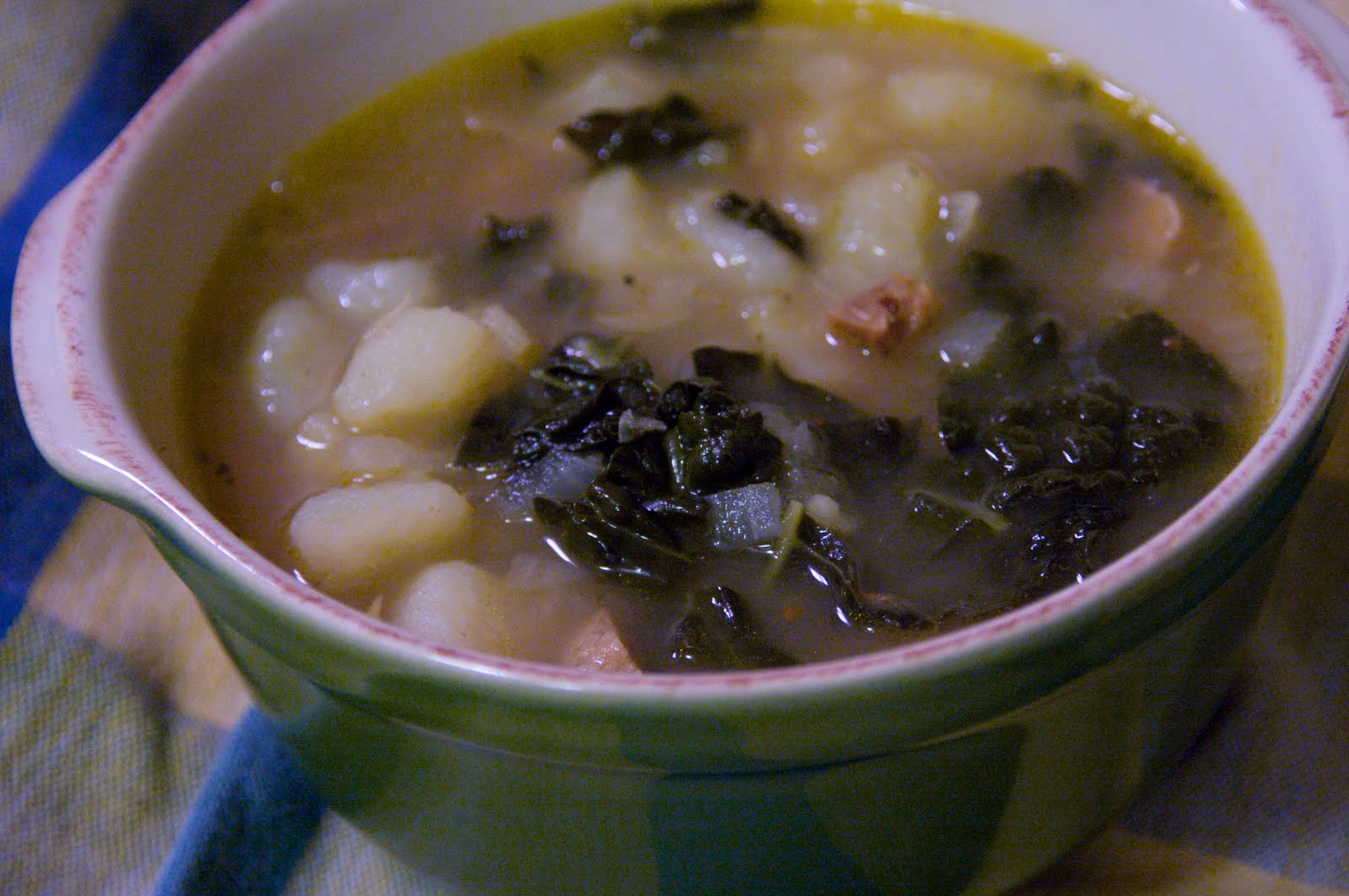
But what a soup! This version of caldo verde, or Portuguese kale soup, comes from Emeril (yes, that Emeril...I know! But stick with me) via The Splendid Table. It's simple, savory, and makes a ton. And it's a great use for the greens that are so plentiful at Seattle farmers markets this time of year. (See? Seasonal. Q.E.D.)
The notes to the original recipe say that the kale should be cooked just a bit and stay crisp-tender, but since I made this a day ahead of eating it the kale ended up pretty thoroughly soft, and I have to admit I really liked it that way. But the best thing about the soup? Is the way the potatoes cook until they start to fall apart--they get almost silky and the starch that they release thickens the soup a bit. Fantastic.
Caldo Verde
Adapted from The Splendid Table
2 medium yellow onions
3 small/medium cloves garlic
2 Tbsp olive oil + a little more, divided
2 lb. potatoes
7 C stock or water
Salt and pepper to taste
2 Tofurkey Italian sausages or similar (or 1/2 lb. chorizo or hot smoked sausage)
1/2 lb. kale (I used lacinato kale because I can't get enough of the stuff; curly kale is probably more authentic)
Crushed red pepper (or add 1/2 tsp to the pot)
Peel the onions and chop them finely. Peel the garlic. Heat 2 Tbsp. of the olive oil in a large soup pot, add the onions, and press the garlic into the pot. Cook, stirring occasionally, until they are soft and translucent. Meanwhile, peel the potatoes and cut them into 1/2-inch cubes. Add the potatoes and stock or water to the pan. Then add salt and pepper, and the crushed red pepper if you don't have sensitive palates in the house. Cover the pot, bring to a boil, then reduce the heat and simmer until the potatoes are tender, about 20 minutes.
While the soup is cooking, wash the kale, cut away the tough center ribs, and cut the leaves into thin strips. When the potatoes are tender, add the kale and simmer until the leaves are softened, about 15 minutes longer. (I put the kale in the soup, turned the heat off, cooled the soup and refrigerated it overnight, then reheated the next day. If you're making the soup the day you plan to eat it and you want the kale really soft, you may need to simmer a little longer. If you're making it a day ahead and want the leaves to stay a little crisp, don't add them until you start reheating the soup the day you're going to eat it.)
Meanwhile, cut the soysages into small dice (or crumble or dice the sausages), and saute in a small skillet in a little bit of olive oil until they are crispy. Then slide them into the soup.
To serve, ladle into bowls and sprinkle each serving with crushed red pepper to taste.
Makes at least 6 servings.
Wednesday, March 31, 2010
ribs
Or stems, if you prefer.
No, not pork ribs, or human stems--nothing quite so decadent. But stay with me. It's just that--now that you are addicted to Swiss chard I bet you are wondering what to do with all those chard middles languishing in your crisper drawer. Am I right?
I am here to help you out.
Well, I'm doing my best anyway. I'm going to tell you up front. My husband's comment on this dish was "I'm glad we're using up the chard stems." As you know, what I'm really aiming for here is more like "Hot damn! Chard stems for dinner!"
And this wasn't quite that. But it has potential, and I think my main mistake was being in too much of a hurry. I recommend that you cook the chard stems until they're downright silky. I took them off the heat when they were still rather crisp and celery-ish.
Give it a try--just be patient.
Swiss Chard Ribs with Goat Cheese and Pasta
Adapted/elaborated from Simply Recipes
Ribs from 2 bunches of Swiss chard
2 Tbsp butter
2 large cloves garlic
1/2 C half-and-half
about 8 oz. dry pasta
3 oz.or so fresh chevre
Salt and pepper
Put a large saucepan or soup pot of salted water on to boil. Wash the chard ribs, trim them, and chop into large-ish pieces. When the water boils, blanch the chard ribs for 3 to 5 minutes. Lift them out with tongs and drain them in a colander. (I know that sounds really specific, but the point is you can save the water to boil your pasta in.)
When the chard ribs are cool enough to handle, chop them into 1/2- to 1-inch pieces. Heat the butter in a large skillet on medium heat. Peel the garlic and press it into the skillet. Saute for a minute or two, then add the chard ribs and saute for a few minutes more. Now add the cream, cover the skillet, turn down the heat, and really just braise the heck out of those chard ribs. Add a little more cream, stock, or water if the skillet gets too dry.
Meanwhile turn on the flame under your pan of water again, and when it returns to a boil add the pasta. Drain when it's al dente.
When the chard ribs are nice and silky, add the drained pasta to the skillet, along with the chevre (crumble it up into little pieces). Toss to heat through and combine, and season with salt and pepper.
Makes 3 to 4 servings.
No, not pork ribs, or human stems--nothing quite so decadent. But stay with me. It's just that--now that you are addicted to Swiss chard I bet you are wondering what to do with all those chard middles languishing in your crisper drawer. Am I right?
I am here to help you out.
Well, I'm doing my best anyway. I'm going to tell you up front. My husband's comment on this dish was "I'm glad we're using up the chard stems." As you know, what I'm really aiming for here is more like "Hot damn! Chard stems for dinner!"
And this wasn't quite that. But it has potential, and I think my main mistake was being in too much of a hurry. I recommend that you cook the chard stems until they're downright silky. I took them off the heat when they were still rather crisp and celery-ish.
Give it a try--just be patient.
Swiss Chard Ribs with Goat Cheese and Pasta
Adapted/elaborated from Simply Recipes
Ribs from 2 bunches of Swiss chard
2 Tbsp butter
2 large cloves garlic
1/2 C half-and-half
about 8 oz. dry pasta
3 oz.or so fresh chevre
Salt and pepper
Put a large saucepan or soup pot of salted water on to boil. Wash the chard ribs, trim them, and chop into large-ish pieces. When the water boils, blanch the chard ribs for 3 to 5 minutes. Lift them out with tongs and drain them in a colander. (I know that sounds really specific, but the point is you can save the water to boil your pasta in.)
When the chard ribs are cool enough to handle, chop them into 1/2- to 1-inch pieces. Heat the butter in a large skillet on medium heat. Peel the garlic and press it into the skillet. Saute for a minute or two, then add the chard ribs and saute for a few minutes more. Now add the cream, cover the skillet, turn down the heat, and really just braise the heck out of those chard ribs. Add a little more cream, stock, or water if the skillet gets too dry.
Meanwhile turn on the flame under your pan of water again, and when it returns to a boil add the pasta. Drain when it's al dente.
When the chard ribs are nice and silky, add the drained pasta to the skillet, along with the chevre (crumble it up into little pieces). Toss to heat through and combine, and season with salt and pepper.
Makes 3 to 4 servings.
Wednesday, March 17, 2010
green day
I'm at most 3 or 4 percent Irish. I was going to say 0 percent, but then I remembered that my grandmother once described her mother as "a duke's mix"--by which I gathered she meant some amalgam of English/Scotch/Irish, though it turns out that the phrase "a duke's mixture" has a more general, and quite fascinating, definition.
(Also, now I want this Duke Ellington CD. Just on principle.)
Anyway I'm certainly 0 percent Irish Catholic. (My great-grandmother must have been vehemently Protestant, else my Dutch Calvinist great-grandfather would never have married her. I'm just reporting, not endorsing, you understand.) I'm sure you know where I'm going with this: St. Patrick's Day has never been a big deal in my household. Still, eating more greens is something I can get behind any day of the year.
Originally, the recipe below was the sauce for a baked chicken dish called Chicken Ala Maria (doesn't that just sound hopelessly '80s?) that we ate fairly frequently when I was growing up. Somewhere along the line, as my family became more veg-centric, the chicken dropped out and the dish turned into a kind of spinach gratin. My mom used to make it with frozen spinach, but I thought I'd see if it would work with chard.
Yes, it would.
In fact, with all apologies to my mom, I think it's better than the original. This version is creamy and comforting but still has a bright-green taste; it's satisfyingly retro without tipping over the top into kitsch.
In light of the discussion above, it also pleases me to realize that I've just taken what started out as a horribly inauthentic American attempt at Italian (?) food, further mongrelized it, and presented it to you for St. Patrick's Day. A duke's mix!
Anyway, whatever you call it, it's very tasty. We ate it with veggie sausages (slice up a small onion and a couple of mushrooms, saute them in olive oil in a large nonstick skillet until caramelized, then deglaze the pan with a bit of balsamic vinegar, and cook two sausages, sliced lengthwise, in the pan), and pasta tossed with oil, garlic, and chili flakes. As close as we get to meat and potatoes around here.
Chard Gratin
3/4 C Italian seasoned breadcrumbs (actually, I think you could decrease this to 1/2 C)
1/4 C grated Parmesan cheese
1 medium yellow onion
2 T butter (or oil)
2 T flour
1 C milk (or broth)
2 good-sized bunches chard, about 12 oz. total
In a small bowl, combine bread crumbs and cheese.
Wash the chard, remove the thick center ribs, and chop roughly. Chop the onion.
In a large skillet melt the butter, then saute the onion until tender. Blend in flour and stir in milk all at once. Cook and stir until thick and bubbly. Stir in the chopped chard and cook, stirring, until wilted.
Spoon into a greased casserole dish and bake, uncovered, at 350 F for 40-45 minutes.
Serves 4 as a side dish.
Subscribe to:
Posts (Atom)